
Temperature
In one sentence: temperature sets how bold the choice is. Low temperature almost always takes the most likely token; high temperature gives more surprising words and more mistakes.
What happens inside
Section titled “What happens inside”At every step the model gives each of the 4,096 tokens it knows a score, called a logit. To turn the scores into chances, the studio divides every score by the temperature and then applies softmax.
- Small temperature (0.2): the gaps between scores grow, and the favourite takes even more.
- Large temperature (1.2): the gaps shrink, the chances even out, and rare tokens get a real chance.
Then one token is drawn at random, weighted by these chances. Temperature does not change what the model knows. It only changes how the draw is weighted.
A real step
Section titled “A real step”The story so far: “Once upon a time there was a little girl named Lily. She loved to play with her toys and”. These are the same model scores at three temperatures, with top-k 40:
| Temperature | her | run | read | sing |
|---|---|---|---|---|
| 0.2 | 43% | 31% | 25% | 0.7% |
| 0.6 (default) | 29% | 26% | 24% | 7% |
| 1.2 | 15% | 14% | 14% | 8% |
At 0.6 the model actually drew read, the third option, and the story continued with “read books”. At 0.2 “sing” practically disappears. At 1.2 the top three are almost equal, and tokens outside the top five together take 43% of the chances, so odd words start to slip in.
Where it is in the studio
Section titled “Where it is in the studio”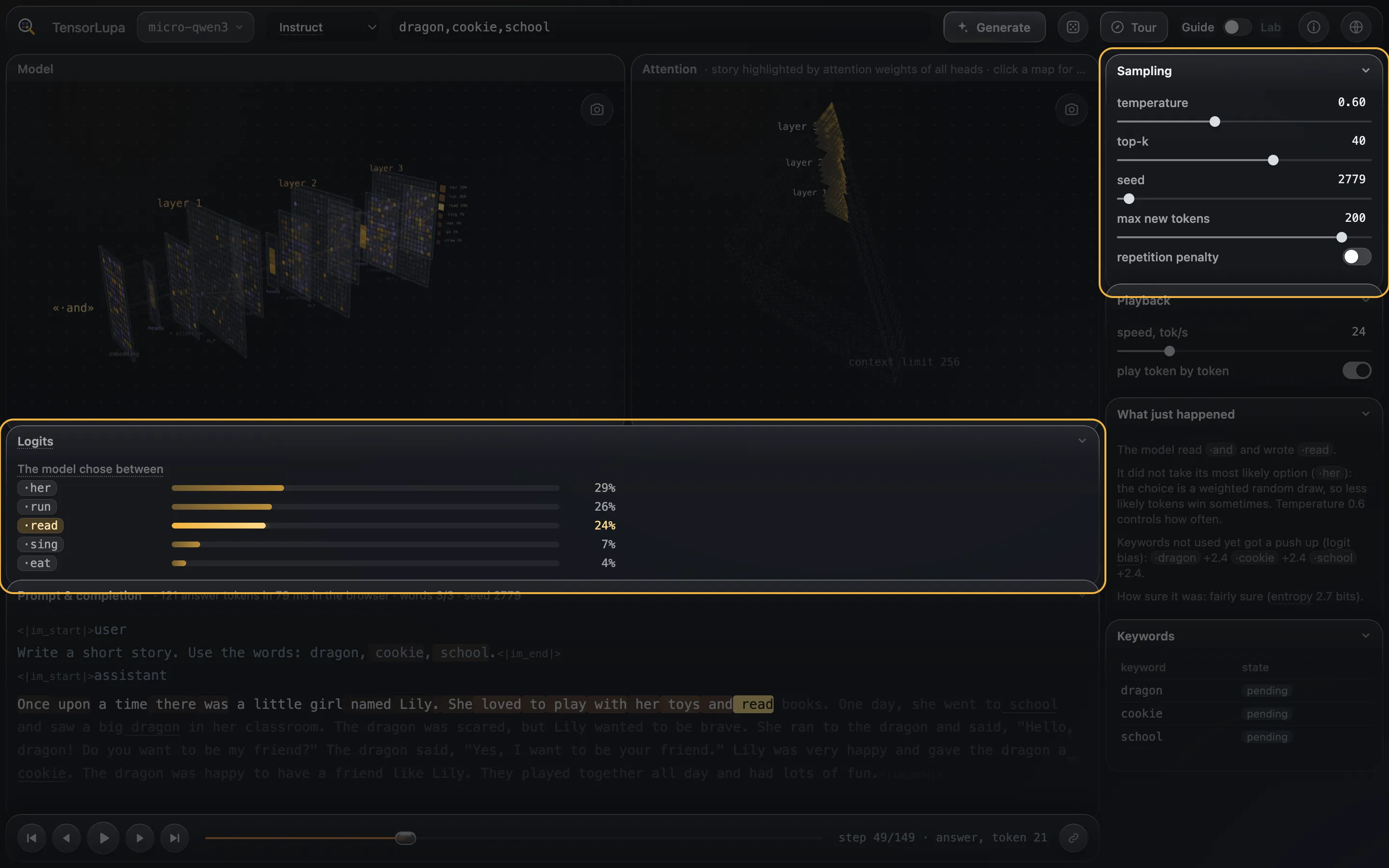
The temperature slider is the first one in the Sampling card, in both Guide and Lab. It goes from 0.05 to 1.5, and the default is 0.6. The candidates it reshapes are in the Logits panel, under “The model chose between”.
Moving the slider reruns the story instantly with the same seed, so every change you see comes from temperature alone. Keep in mind that once one earlier token changes, everything after it is a different story.
Try it
Section titled “Try it”Then drag the temperature slider and watch the bars under “The model chose between” sharpen and flatten.
In micro-qwen3
Section titled “In micro-qwen3”We picked 0.6 by measuring 200 story orders of three words each:
| Temperature | All three words used | Repeated 4-word phrases | Story ends on its own |
|---|---|---|---|
| 0.5 | 99.5% | 7.2% | 87.5% |
| 0.6 | 100% | 4.5% | 87.0% |
| 0.7 | 98.0% | 4.0% | 82.0% |
| 0.8 | 99.5% | 2.0% | 82.5% |
| 1.0 | 99.0% | 0.7% | 81.5% |
From 0.5 to 0.6 repetition drops by more than a third, while stories still end cleanly as often. Above 0.7 the model starts to make up words and finishes on its own less often.
Related
Section titled “Related”- Top-k decides how many candidates get a chance at all; temperature then shapes their chances.
- Seed fixes the random draw, so the same seed and settings give the same story.
- Logits are the raw scores that temperature divides.